
Travel Technology

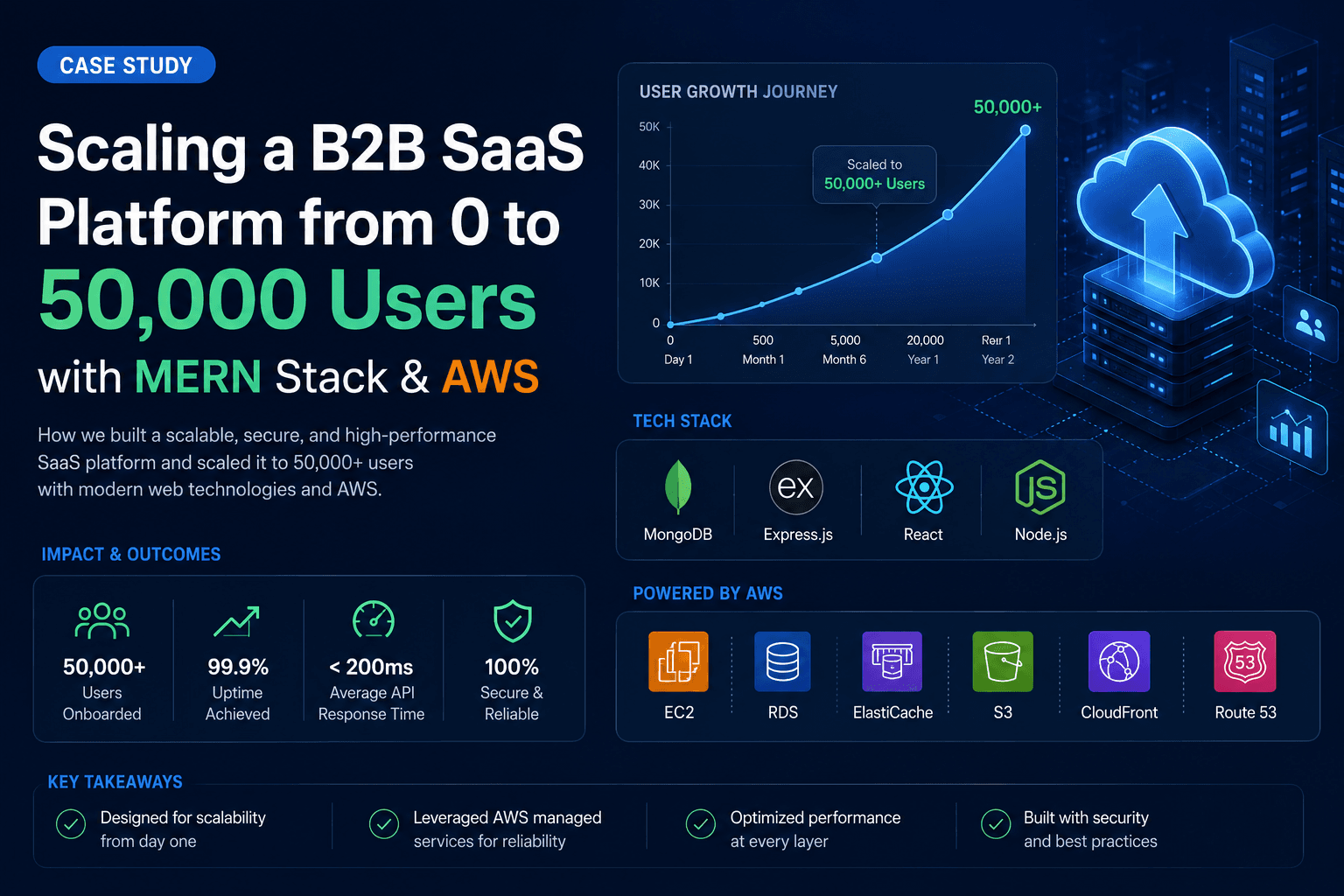
Scaling a B2B SaaS Platform from 0 to 50,000 Users with MERN Stack & AWS

SaaS, MERN Stack, AWS Cloud Infrastructure

Appia's MERN stack developers built and scaled a B2B SaaS platform from MVP to 50,000 active users — architected on AWS with auto-scaling, 99.98% uptime, and a load time under 1.2 seconds globally. Here's how they did it.

Scaling a B2B SaaS Platform from 0 to 50,000 Users with MERN Stack & AWS banner

99.98%

Platform Uptime

Background

The client — a UK-based startup — had a strong product concept: a workflow automation platform designed for operations teams at mid-market companies. They had funding, a go-to-market plan, and a small in-house team. What they didn't have was the engineering bandwidth to build something that could handle rapid user growth without crumbling under load. They came to Appia needing a team that could move fast, think long-term, and build something they wouldn't have to rebuild in 18 months.

Challenge

The startup needed more than just a working MVP — they needed an architecture that could grow with them. Early prototypes built internally were already showing cracks at just a few hundred concurrent users. The real engineering challenge was designing a system where the database, API layer, and front-end could each scale independently — without the cost of a full microservices overhaul at MVP stage. On top of that, the product needed to comply with UK GDPR requirements and support real-time collaboration features, which added significant complexity to the data layer.

Solution

Appia deployed a senior MERN Stack engineering team who designed the full-stack architecture from scratch on AWS, built for both speed-to-market and long-term scale.

  1. Scalable MERN Architecture — Built with React.js (front-end), Node.js + Express (API layer), and MongoDB Atlas — structured so each layer could be scaled or swapped independently as the product evolved.
  2. AWS Cloud Infrastructure — Deployed on AWS with EC2 auto-scaling groups, Application Load Balancer, S3 + CloudFront CDN for static assets, and RDS for relational data where needed — keeping costs predictable during growth phases.
  3. Real-Time Features via WebSockets — Implemented Socket.io for live collaboration, instant notifications, and multi-user workflow editing — a key product differentiator for the client.
  4. CI/CD Pipeline & DevOps — Set up GitHub Actions pipelines with automated testing, staging environments, and zero-downtime blue-green deployments on AWS ECS.
  5. GDPR Compliance Layer — Built data residency controls, consent management, right-to-erasure workflows, and encrypted PII storage in line with UK GDPR requirements.

Results

The platform launched on schedule and handled its first major traffic spike — a Product Hunt launch that drove 8,000 sign-ups in 48 hours — without a single incident. Over the following 14 months, the product scaled to 50,000 active users while maintaining 99.98% uptime and sub-1.2 second load times globally. AWS infrastructure costs scaled sub-linearly with user growth, saving the client an estimated $180,000 compared to their original provisioning plan. The real-time collaboration feature became the most praised aspect in user reviews — something the client credits entirely to Appia's implementation of the WebSocket architecture.

Testimonials

P

Priya Nair, CTO & Co-Founder, WorkflowOS (UK)

Appia's developers didn't just write code — they made decisions that saved us from expensive mistakes down the road. When we hit 50,000 users and the platform didn't flinch, I knew we'd made the right call partnering with them from day one.

Start growing with Appia

Tell us what you are building—we will help you define the roadmap, ship with confidence, and scale delivery without losing quality.

Related case studies

More ways teams partner with Appia to ship outcomes that last.