
Healthcare

How We Diagnosed Website Instability and Reduced Database Load for an Insurance Website

Insurance · Website Reliability & Performance

An insurance provider's website kept hitting its hosting database limits, slowing down and going offline at peak times. Appia traced the root cause to a custom premium-calculator plugin, rebuilt its data layer, and cut database load by 70% while bringing page response times under one second.

How We Diagnosed Website Instability and Reduced Database Load for an Insurance Website banner

70%

Reduction in Database Queries

<1s

Average Server Response Time

0

Downtime Incidents in 90 Days Post-Fix

Background

The client is an insurance provider whose website is its main channel for lead generation. Visitors compare plans, use an online premium calculator to get an instant quote, and submit enquiries that go straight to the sales team. When the website is slow or offline, the business loses leads in real time.

The site ran on WordPress with a custom calculator plugin built by a previous vendor. Over time it had become unreliable, and the in-house team couldn't tell whether the problem was the hosting, the theme, traffic, or the code. They came to Appia needing a clear diagnosis and a fix they could trust, not another round of guesswork.

Challenge

The website showed three connected symptoms:

  • Database usage limits — The hosting provider repeatedly flagged the account for exceeding database usage limits, which triggered throttling and, on several occasions, temporary suspension.
  • Stale calculator data — The premium calculator sometimes displayed outdated rates, even after the team had updated them in the admin panel, which undermined confidence in the quotes visitors received.
  • Intermittent instability — Pages slowed down sharply or returned errors during busy periods, with no clear pattern the team could reproduce.

The obvious fix was to upgrade the hosting plan. But without knowing the root cause, a bigger plan would only have raised the monthly bill while the underlying problem kept growing.

Solution

Appia treated the problem as a production investigation: measure first, find the root cause, fix it in the code, then prove the fix in production.

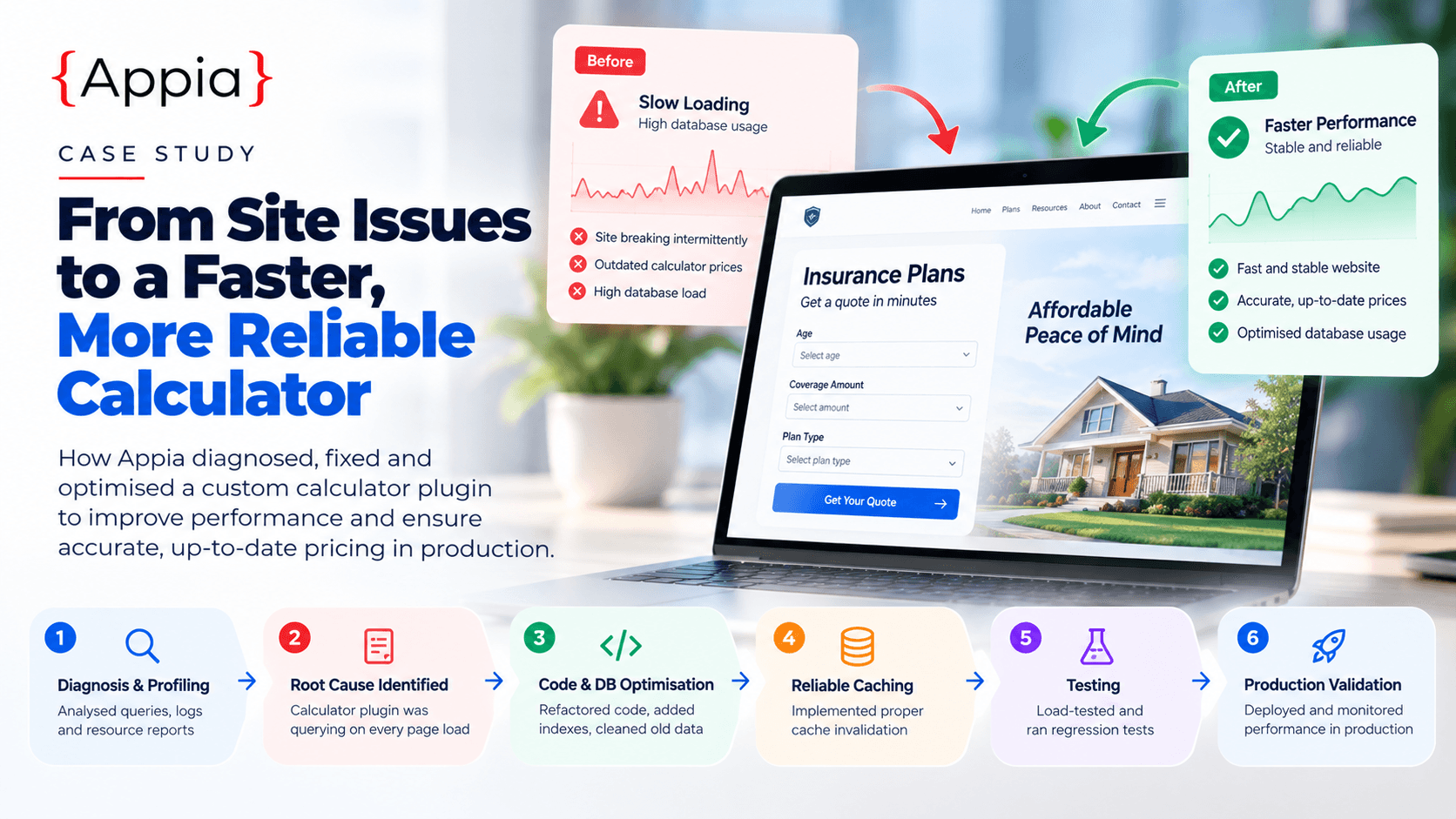
  1. Diagnosis & Profiling — Enabled slow-query logging and query profiling on a staging copy of the site, and reviewed hosting resource reports alongside server and PHP error logs. This showed that most database load came from a single source: the custom calculator plugin.
  2. Root Cause Identified — The plugin queried rate tables on every page load, not just when a visitor used the calculator, and it ran repeated unindexed lookups for each calculation. It also wrote results to a cache that was never invalidated when rates changed, which is why visitors saw stale prices. In short, the same flaw that was overloading the database was also serving outdated data.
  3. Code & Database Optimisation — Refactored the plugin so it only loads on pages that use the calculator, replaced repeated lookups with a single optimised query, added indexes to the rate tables, and cleared out years of expired transients and orphaned option rows that had bloated the database.
  4. Reliable Caching — Rebuilt the caching layer with proper invalidation: when an admin updates rates, the related cache entries are cleared immediately, so visitors always see current prices without the site hitting the database on every request.
  5. Testing — Load-tested the staging site against realistic peak traffic, ran regression tests comparing calculator outputs against the official rate tables, and checked key user journeys (plan pages, quote, enquiry form) across devices.
  6. Production Validation — Deployed during a low-traffic window with a rollback plan ready, then monitored database usage, response times, error logs, and hosting resource reports for several weeks to confirm the improvement held under real traffic.

Results

Once the fix went live, database queries fell by around 70% and the site stopped hitting its hosting usage limits, so the client never needed the hosting upgrade it had been considering. Average server response time dropped below one second, and the slowdowns and error pages during busy periods stopped. The calculator now shows current rates as soon as the team updates them.

Just as important, the client now understands why the problem happened. Appia handed over a short technical report covering the root cause, the changes made, and the metrics to watch, so the team can spot similar issues early instead of reacting to outages.

Start growing with Appia

Tell us what you are building—we will help you define the roadmap, ship with confidence, and scale delivery without losing quality.

Related case studies

More ways teams partner with Appia to ship outcomes that last.

How We Helped a Financial Services Company Modernize Its CRM and Sales OperationsFinancial services

Financial Services · Microsoft Dynamics 365

How We Helped a Financial Services Company Modernize Its CRM and Sales Operations

A US financial services company was running its sales operation on disconnected spreadsheets and manual reports. Appia delivered a customised Microsoft Dynamics 365 CRM with tailored modules, automated workflows, system integrations, and live dashboards, giving leadership a real-time view of the pipeline and freeing the sales team from hours of admin.

80%

Shorter Sales Cycle

Read case study