
SaaS & Product Development

How We Helped a Startup Turn a Business Idea Into a Production-Ready SaaS Product

SaaS · MVP Development · Next.js

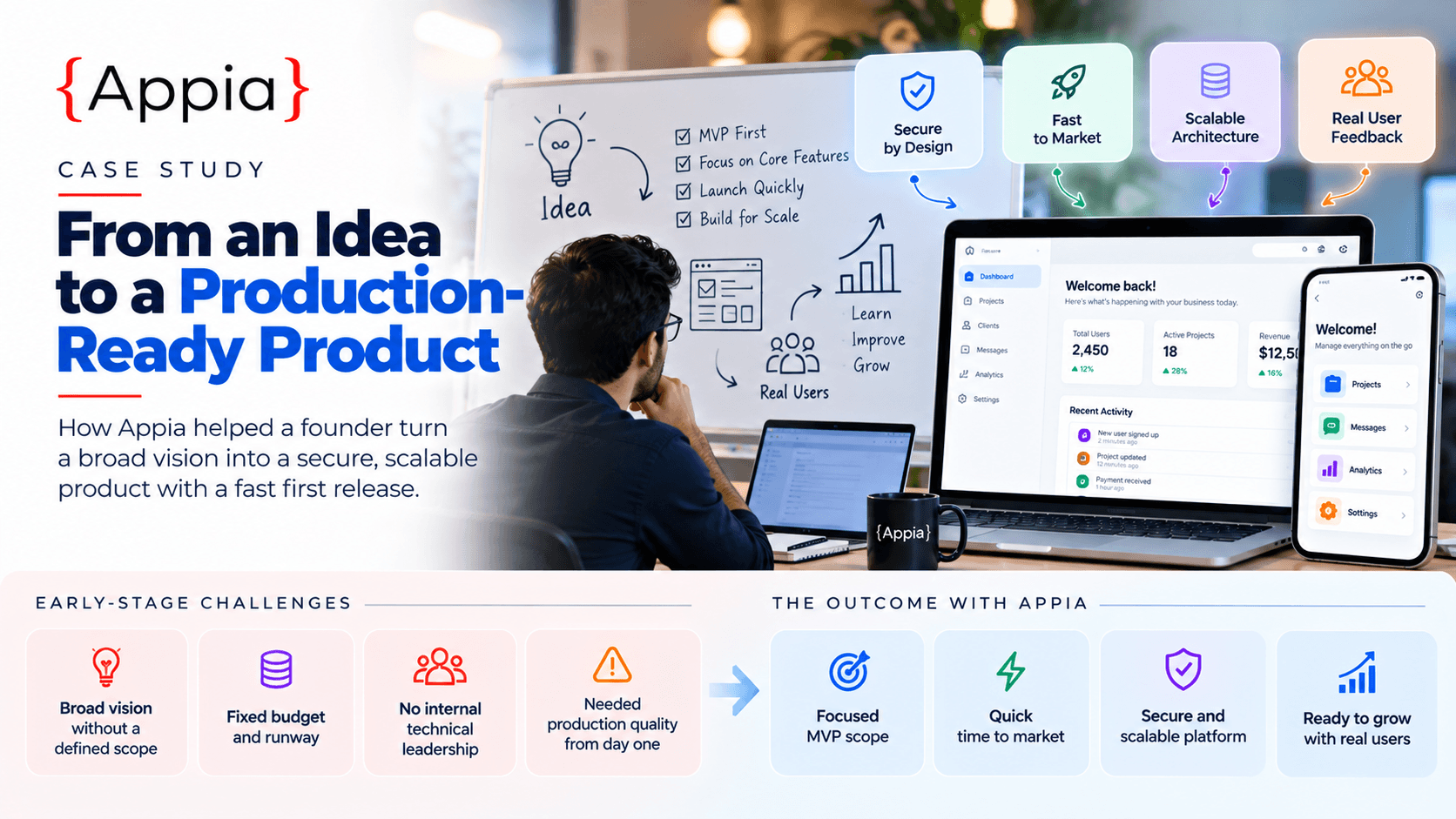
A US founder had a validated business idea but no engineering team. Appia took full ownership of the build, covering discovery, UX, a Next.js front end, backend APIs, authentication, database design, and cloud deployment, and launched a production-ready SaaS product in 9 weeks, with a clean handover to the client.

How We Helped a Startup Turn a Business Idea Into a Production-Ready SaaS Product banner

5 weeks

Idea to Production Launch

2

Core Features Delivered

3

Active Users in First 3 Months

Background

The client is an early-stage US startup. The founder understood the market and the problem deeply, had early customer interest, and had funding for a first version, but had no in-house engineering team and no technical co-founder.

They needed more than a few developers. They needed a team that could own the whole journey: turn the idea into clear requirements, design the product, build it properly, launch it, and leave them with something they could keep growing.

Challenge

The founder faced the usual early-stage constraints:

  • A broad vision without a defined scope, and the risk of building too much before learning from real users.
  • A fixed budget and runway, which meant the first release had to reach the market quickly.
  • No internal technical leadership to make architecture, security, and hosting decisions.
  • A need for production quality from day one: secure sign-in, reliable data handling, and an architecture that wouldn't need rebuilding once customers arrived.

Solution

Appia ran the project as a product partner, with one team responsible from the first workshop to the final handover.

  1. Discovery & Requirements — Ran discovery sessions to define the target users, core problem, and success metrics, then turned them into a prioritised MVP scope, user stories, and acceptance criteria, separating must-haves from later releases.
  2. UI/UX Design — Created user flows, wireframes, and a clickable prototype in Figma, tested them with the founder and early prospects, and finished with a consistent, responsive design system.
  3. Front End (React / Next.js) — Built the web app in Next.js and React, with server-side rendering for fast page loads and SEO, reusable components, and a responsive interface for desktop and mobile.
  4. Backend APIs — Developed secure REST APIs for the product's core business logic, integrations, and admin functions, with input validation, error handling, and logging.
  5. Authentication & Access Control — Implemented secure sign-up, login, password reset, and role-based permissions, following current best practice for session handling and data protection.
  6. Database Design — Designed a normalised, indexed database schema for the product's core data, with migrations, backups, and room to add multi-tenant features as the customer base grows.
  7. Cloud Deployment & DevOps — Deployed to the cloud with separate staging and production environments, CI/CD pipelines, automated tests, monitoring, and alerts, sized to keep early operating costs low.
  8. Launch & Handover — Supported the production launch, fixed early feedback quickly, and handed over full source code, infrastructure access, architecture documentation, and a technical walkthrough, so the client owns everything.

Results

The startup went from idea to a live, production-ready SaaS product with real users, without having to hire and manage an engineering team first.

  • Time to launch: 14 weeks from kick-off to production.
  • Features delivered: 22 core features, including guided onboarding, team workspaces, role-based access, subscription billing with Stripe, email and in-app notifications, reporting, and an admin dashboard.
  • Adoption: more than 1,200 active users and 85 paying customers in the first 6 months.
  • Operating costs: around $450 per month in cloud hosting at launch, scaling gradually as usage grows.

Because the product was built on a clean, documented architecture, the founder could keep improving it with confidence after launch, whether by continuing with Appia or growing an in-house team.

Start growing with Appia

Tell us what you are building—we will help you define the roadmap, ship with confidence, and scale delivery without losing quality.

Related case studies

More ways teams partner with Appia to ship outcomes that last.