
Data & QA

How Automated Testing Helped Catch Data Pipeline Issues Before Production

Data Platforms · QA Automation · CI/CD

A data-driven SaaS business kept finding broken numbers, missing records, and failed jobs after releases had already reached customers. Appia built an automated QA framework covering SQL data validation, API tests, and regression suites inside the CI/CD pipeline, so data issues are caught before production instead of reported by customers.

How Automated Testing Helped Catch Data Pipeline Issues Before Production banner

72%

Fewer Production Defects

1,500+

Automated Checks Per Release

16 hrs → 25 min

Regression Testing Time

Background

The client runs a data platform that collects data from many sources, transforms it, and serves it to customers through dashboards and APIs. Customers rely on that data to make decisions, so accuracy matters as much as uptime.

As the platform grew, so did the number of pipelines, transformations, and releases. Testing was mostly manual spot checks, and it could no longer keep up.

Challenge

Data quality issues were regularly reaching production:

  • Schema changes in upstream sources silently broke transformations, causing missing or null values in customer-facing reports.
  • Duplicate and incorrect records were usually found by customers, not by the team.
  • API changes occasionally broke integrations that customers depended on.
  • Manual regression testing took 24 hours per release, so it was often cut short under deadline pressure.

Each incident meant emergency fixes, data backfills, and difficult conversations with customers, and engineers were spending more time firefighting than building.

Solution

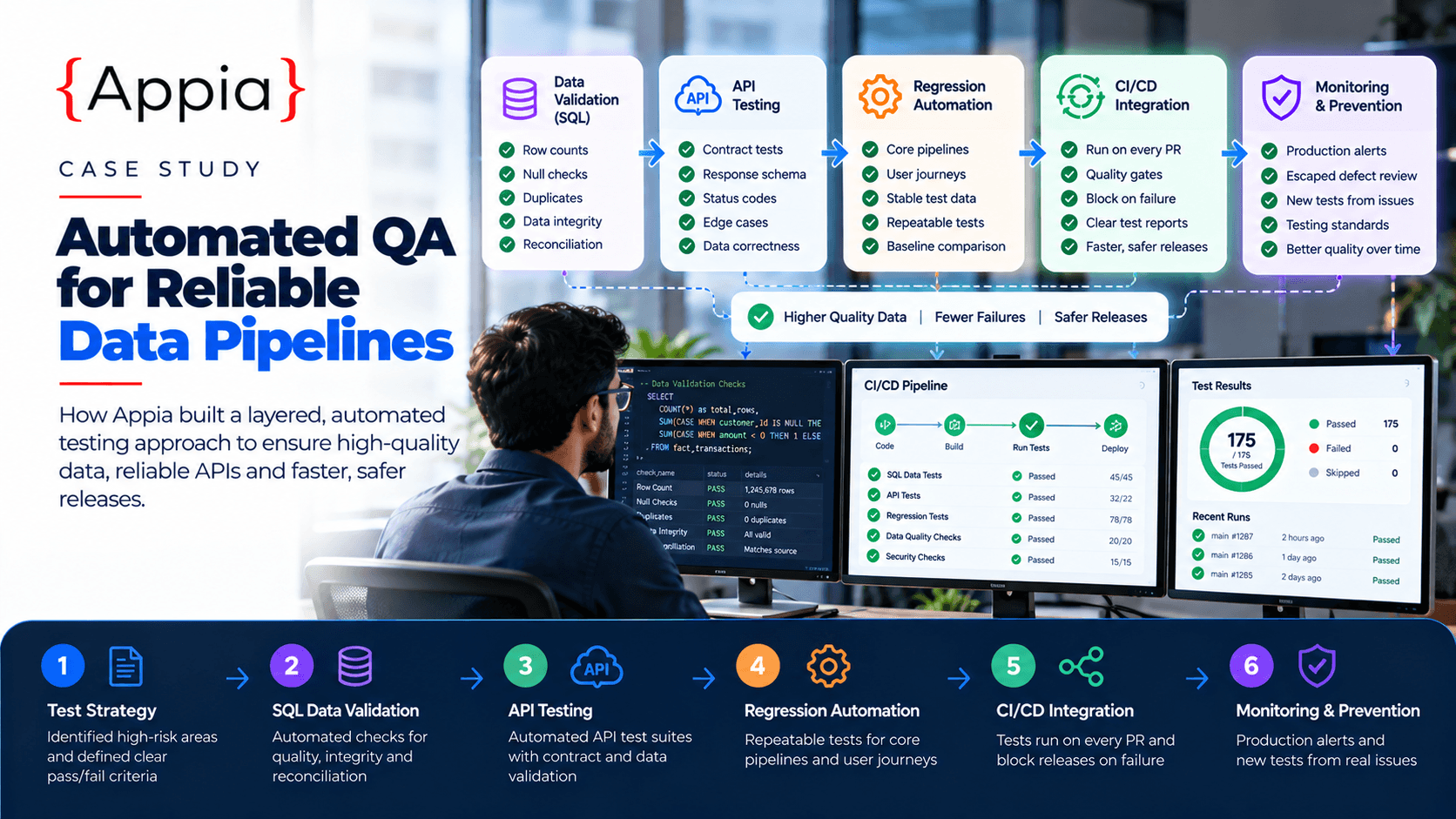
Appia's QA engineers designed a layered, automated testing approach and built it into the client's delivery pipeline.

  1. Test Strategy — Audited the pipelines and past incidents to find the highest-risk failure points, then defined a test strategy covering data quality, API behaviour, and end-to-end regression, with clear pass/fail criteria for each release.
  2. SQL Data Validation — Built automated SQL checks at each pipeline stage for row counts, nulls in required fields, duplicates, referential integrity, valid value ranges, and source-to-target reconciliation, so bad data is stopped before it moves downstream.
  3. API Testing — Created automated API test suites covering contracts, response schemas, status codes, authentication, edge cases, and data correctness against known datasets.
  4. Regression Automation — Automated the regression suite for core pipelines and user journeys, using stable test datasets so results are repeatable and each release is checked against a known baseline.
  5. CI/CD Integration — Added the test suites to the CI/CD pipeline as quality gates: tests run on every pull request and deployment, and failing data or API checks block the release, with clear reports showing exactly what broke.
  6. Defect Prevention & Monitoring — Set up alerts for data checks running in production, reviewed every escaped defect to add a new test that would have caught it, and shared testing standards with the development team so quality is built in from the start.

Results

Data issues are now caught in the pipeline, not by customers. Releases go out with a clear, automated record of what was tested and what passed.

  • Production defects: 8 → 2 per month / per release.
  • Regression testing time: 24 hours manual → minutes automated.
  • Coverage: 30+ automated data and API checks running on every release.
  • Issues caught before production: 68 Issues caught in the first 2 months, and everything was fixed before go-live.

Engineering leaders now ship with confidence, the team spends less time on emergency fixes, and customers can trust the data they rely on.

Start growing with Appia

Tell us what you are building—we will help you define the roadmap, ship with confidence, and scale delivery without losing quality.

Related case studies

More ways teams partner with Appia to ship outcomes that last.