
Staff Augmentation

How an Engineering Partner Helped a Delivery Team Close a Critical Skills Gap

Staff Augmentation · Dedicated Engineers

A US delivery team was stuck: key milestones depended on specialist skills it couldn't hire for fast enough. Appia supplied pre-screened, in-house engineers who were onboarded in 12 days, joined the client's sprints as part of the team, and helped ship the milestones that had been blocked.

How an Engineering Partner Helped a Delivery Team Close a Critical Skills Gap banner

12 days

Time to Fill

5 days

Onboarding to First Commit

100%

Engineer Retention

Background

The client is a US technology delivery team running several client projects at once. A major engagement had reached a stage that needed specialist skills its current team didn't have enough of, and the delivery dates were already agreed with its own customer.

It needed experienced engineers who could join quickly, work inside its existing processes, and contribute from the first sprints, without the overhead of a long recruitment cycle.

Challenge

The project was blocked by a hiring bottleneck:

  • Open roles had been unfilled for 10 weeks, and the local market for these skills was slow and expensive.
  • The specific skills required were senior React and Node.js development, .NET and Azure integration, and QA automation, with enough seniority to work independently.
  • Every week of delay put contractual milestones and the client relationship at risk.
  • New engineers had to fit the team's existing tools, code standards, and sprint process without slowing down the people already on the project.

Solution

Appia provided dedicated engineers from its in-house team and treated integration as part of the job, not something left to the client.

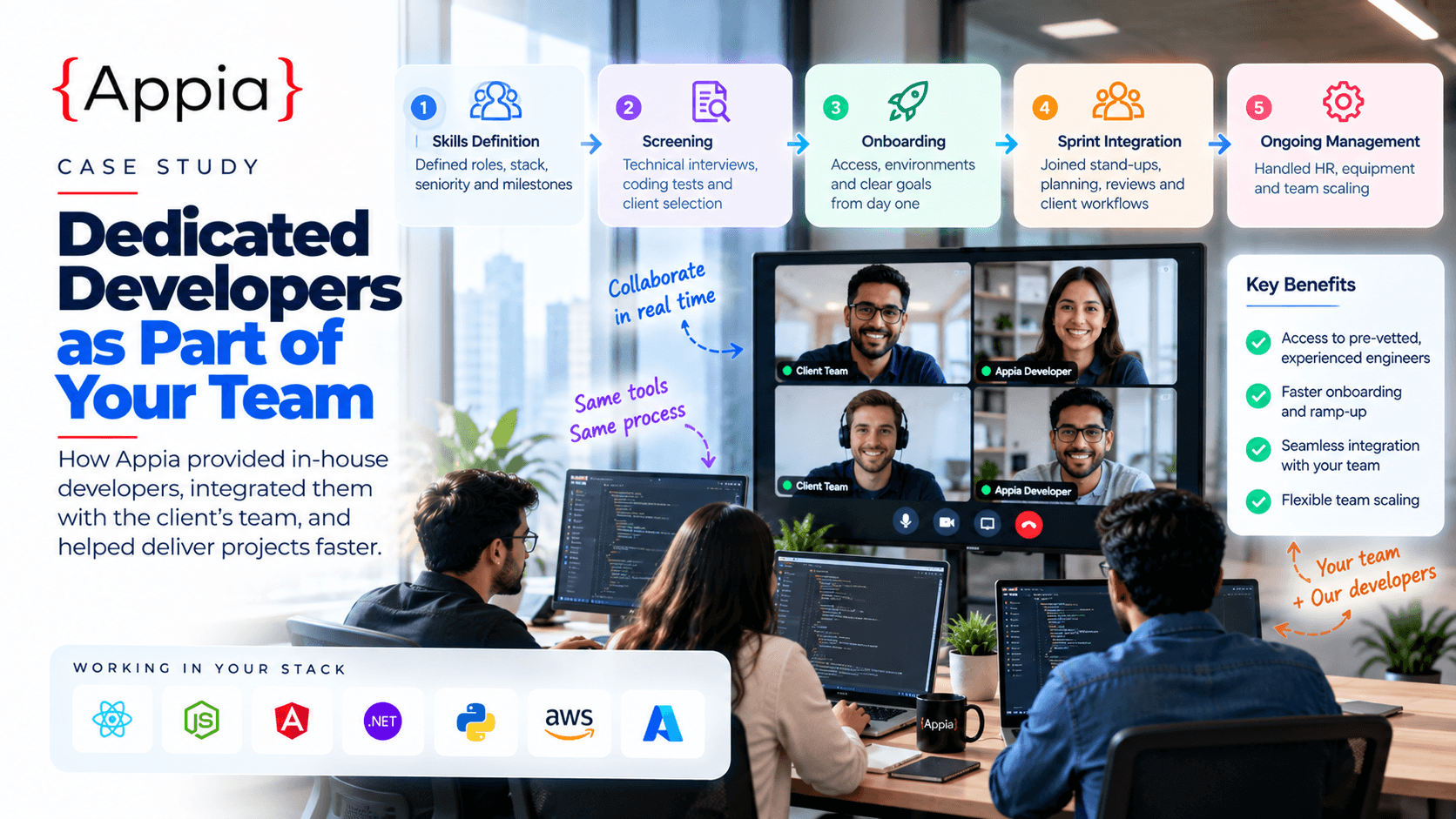
  1. Skills Definition — Worked with the client's delivery lead to define each role precisely: the tech stack, seniority, time-zone overlap, and the milestone each engineer would support.
  2. Screening — Shortlisted engineers from Appia's in-house team and put them through technical interviews, practical coding exercises in the client's stack, and communication checks. The client interviewed the final candidates and made the selection.
  3. Onboarding — Prepared access, environments, and documentation before day one, paired each engineer with a client-side point of contact, and set clear goals for the first two weeks, so new team members were productive quickly.
  4. Sprint Integration — Engineers joined the client's stand-ups, sprint planning, reviews, and retrospectives, worked in its Jira and Git workflow, and followed its code review and release standards, working as part of the team rather than an outside vendor.
  5. Ongoing Management — Appia handled HR, equipment, and continuity, held regular check-ins with the client's delivery lead, and kept a plan in place to replace engineers or scale the team up or down as needed.

Results

The blocked work started moving again within weeks, and the client met its commitments to its own customer.

  • Time to fill: 12 days from the initial request to four engineers starting on the project.
  • Onboarding duration: 5 days to the first merged pull request, with full independent sprint contribution by the second sprint.
  • Retention: 100% of the placed engineers were still on the engagement after 12 months.
  • Delivery outcomes: the team delivered 3 blocked milestones, including a customer portal launch and a legacy API migration, and the project hit its final release date.

The client now has a flexible way to add proven engineering capacity whenever a project needs it, without the cost and delay of permanent hiring.

Start growing with Appia

Tell us what you are building—we will help you define the roadmap, ship with confidence, and scale delivery without losing quality.

Related case studies

More ways teams partner with Appia to ship outcomes that last.