
Insights
AI Automation in Dubai: Use Cases, Compliance, and a Pilot-to-Production Roadmap for UAE Businesses
Dubai has set some of the world's most ambitious AI targets, and businesses across real estate, logistics, hospitality, retail and financial services are under pressure to show results. Yet many AI projects stall after an impressive demo. This guide covers where AI automation pays back for UAE companies, what you must get right on data and language, and how to move from pilot to production.
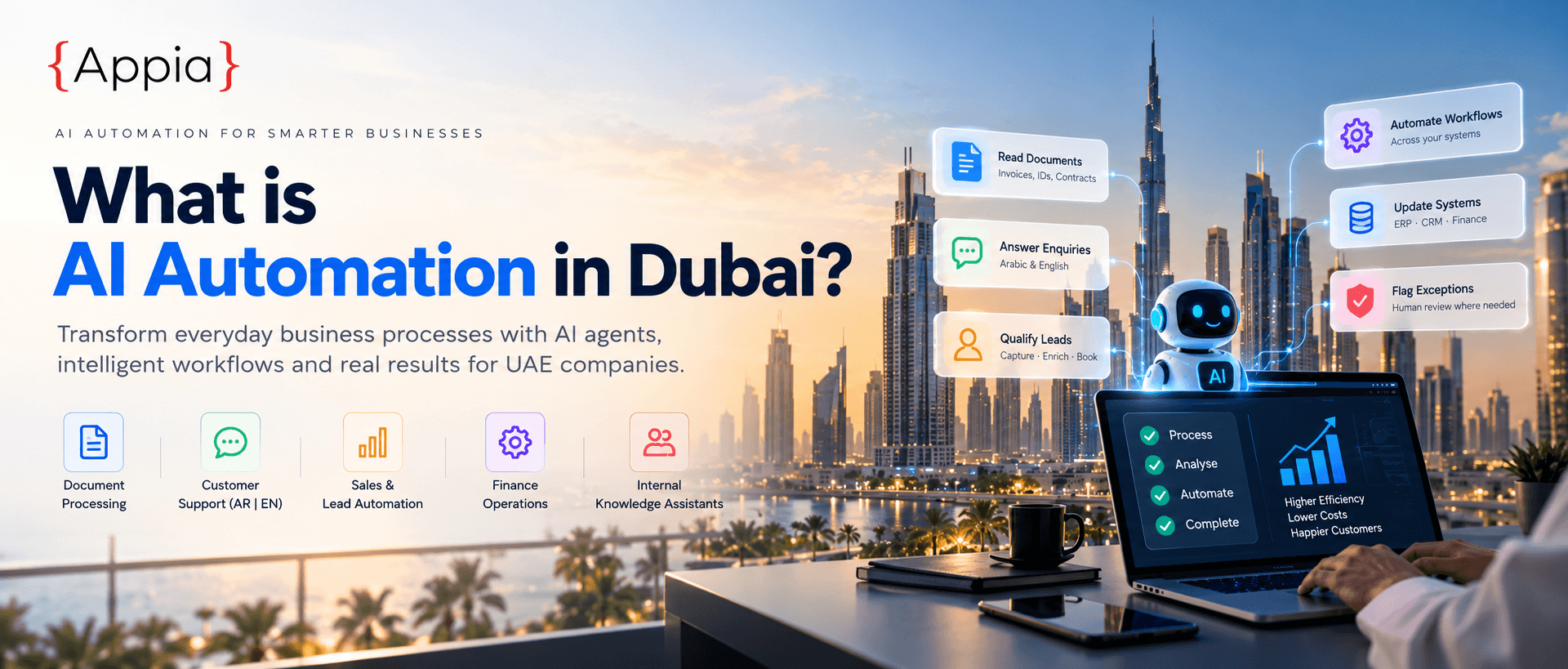
What is AI automation in Dubai?
AI automation is the use of AI agents, large language models and intelligent workflows to complete business tasks that previously needed manual effort: reading documents, answering enquiries, routing requests, updating systems and flagging exceptions. Unlike traditional rule-based automation (RPA), AI automation can handle unstructured inputs such as emails, PDFs, voice notes and WhatsApp messages in both Arabic and English.
For Dubai businesses, the question is no longer whether to adopt AI. It is which processes to automate first and how to do it safely. If you want help choosing, see Appia's AI automation services or contact our team.
Why Dubai businesses are prioritising AI automation
- Clear government direction. The UAE National Strategy for Artificial Intelligence 2031 and the Dubai Universal Blueprint for AI signal long-term commitment, linked to the D33 economic agenda's productivity goals.
- Talent and cost pressure. Hiring for operations, customer service and finance roles is competitive, and automation lets existing teams handle more volume.
- Multilingual customers. Serving customers in Arabic, English and other languages around the clock is hard to staff but well suited to AI assistants.
- Compliance-heavy workflows. KYC checks, trade documents and the national e-invoicing rollout create structured, repeatable work that AI can speed up.
High-ROI AI automation use cases for UAE companies
Document processing
Extract and validate data from invoices, purchase orders, bills of lading, contracts, Emirates ID and trade licence copies. AI reads the document, checks it against your rules and pushes clean data into your ERP or CRM, sending exceptions to a person for review.
Bilingual customer service assistants
Web and WhatsApp assistants that answer common questions, check booking or order status, and hand over to a human agent with full context. Useful for hospitality, retail, real estate and healthcare clinics.
Lead qualification and sales operations
Real estate brokers and B2B sellers receive large volumes of enquiries from portals, ads and social channels. An AI agent can qualify leads, enrich them, book viewings or meetings and update the CRM within minutes instead of hours.
Finance operations
Invoice matching, payment reconciliation, expense review and e-invoicing data preparation. These are high-volume, rules-heavy processes where automation reduces errors and month-end pressure.
Internal knowledge assistants
Retrieval-augmented generation (RAG) assistants that answer staff questions from your policies, SOPs and product documentation, with links to the source documents so answers can be checked.
What UAE businesses must get right
Data protection and residency
Under the UAE PDPL, personal data processing needs a lawful basis, data minimisation, security controls and contracts with every processor, including AI model and cloud providers. DIFC and ADGM entities follow their own data protection regimes, and regulated sectors such as health and finance may restrict where data is stored. Map data flows before choosing models or hosting regions.
Arabic language quality
Test models on real Arabic and mixed Arabic-English inputs, including Gulf dialect, names and addresses. Measure accuracy per language rather than overall, and route low-confidence cases to people.
Human-in-the-loop for high-risk steps
Keep human approval for payments, credit decisions, medical information, legal commitments and anything customer-facing that cannot be undone. Automation should prepare and recommend; people approve where risk is high.
Governance and auditability
Log every AI decision, input and output. Define who owns each automation, how errors are reported and how models are updated. This protects you during audits and builds trust with management.
Roadmap: Pilot → Production → Compound
Appia Consultancy Services uses a three-stage roadmap with exit criteria at each stage:
- Pilot (4–8 weeks): pick one high-volume process, set a baseline, build the workflow and test it on real cases. Exit: measurable improvement against the baseline and an approved risk review.
- Production (6–12 weeks): integrate with core systems, add monitoring, access controls, audit logs and fallback paths, and train the team. Exit: stable operation at target volume with agreed service levels.
- Compound (ongoing): reuse the same data pipelines, guardrails and integrations to automate adjacent processes, so each new automation is faster and cheaper than the last.
How to measure AI automation ROI
Track a small set of metrics against your pre-pilot baseline:
- Hours saved per week and the capacity freed for higher-value work
- Turnaround time from request to completion
- Error and rework rate
- Cost per transaction, including model usage, hosting and human review
- Customer or employee satisfaction for assisted workflows
If a pilot cannot show movement on at least one of these, change the scope before scaling.
Build in-house or work with a partner?
Build in-house when AI is a core product capability and you can hire and retain AI engineers. Work with a partner when you need results within a quarter, lack specialist skills, or want proven guardrails and integration patterns. Many UAE companies combine both: a partner delivers the first production use cases while training an internal team to own them. Appia supports both through managed pods and flexible engineering capacity, with delivery from India just 1.5 hours ahead of Dubai.
Start with one process
The fastest path to value is one well-chosen process, measured honestly and scaled with discipline. Book a free AI automation discovery session with Appia and we will help you identify your highest-ROI use case and plan a pilot. You can also read our guide to what AI agents are.