
Insights
How Appia Consultation Helps Startups Scale Faster
Startups rarely fail from a bad idea -- they stall from scaling the wrong things too early, or the right things too late. Here's how Appia Consultation helps founders build a technical foundation that can actually take the growth.
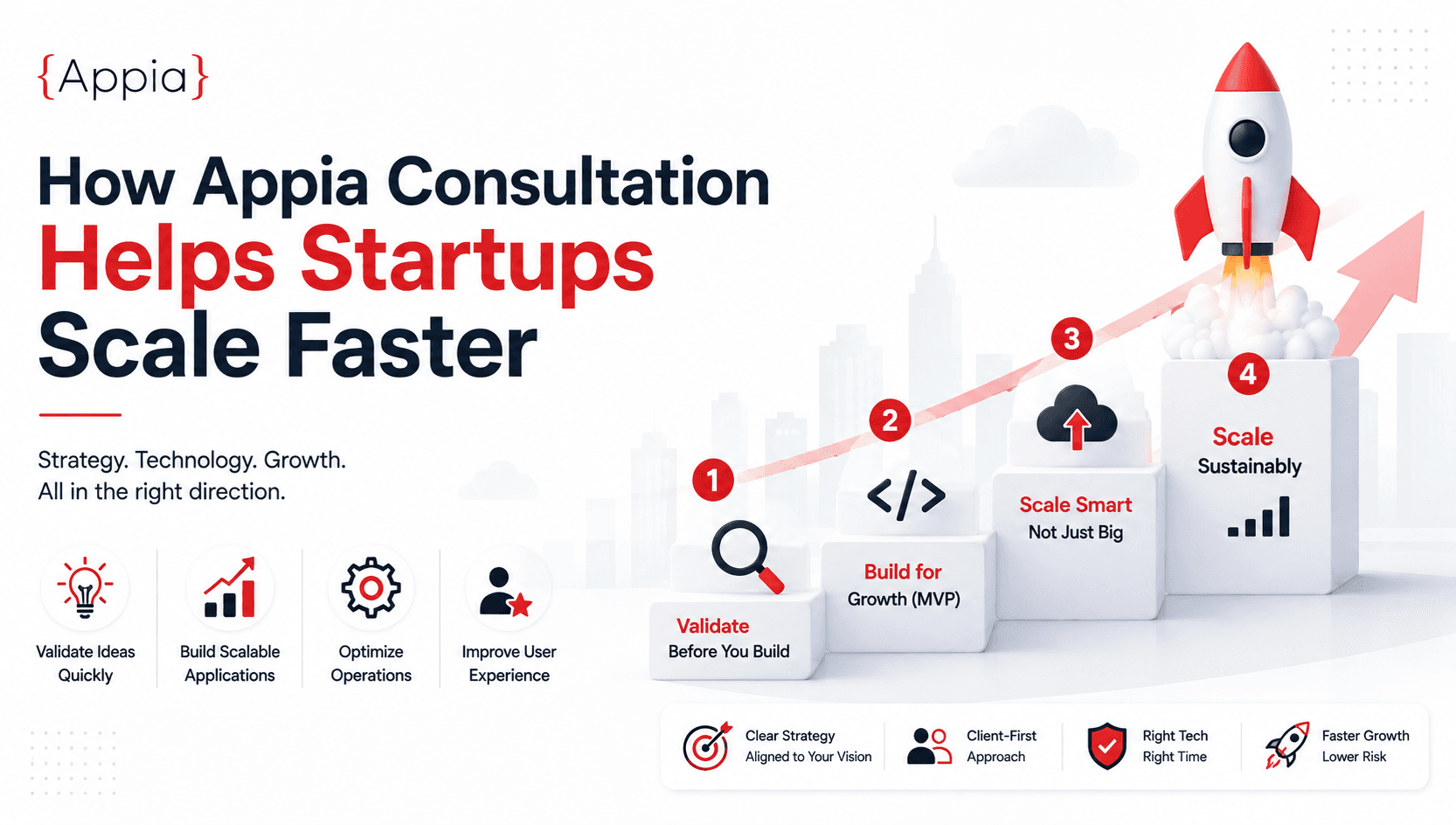
Why startups stall, even with a good idea
Startups often struggle with scaling due to limited resources, unclear strategy, and technical challenges — not because the idea was wrong. This is where Appia Consultation plays a crucial role: building a strong foundation for startups by combining business strategy with modern technology.
Building for growth from the MVP stage
From MVP development to scaling infrastructure, we make sure a product is built to grow instead of needing a rebuild the moment traction hits. That means:
- Validate ideas quickly
- Build scalable applications
- Optimize operations
- Improve user experience
Validation before investment
The cheapest mistake to avoid is building the wrong thing well. Before committing engineering time to a feature or a full platform, we help founders test the riskiest assumption first — often with something far smaller than a full build.
Scaling infrastructure without over-engineering
Early-stage teams sometimes over-build for scale they don't have yet, burning runway on infrastructure the business doesn't need for another year. The better approach is building for the growth that's actually likely in the next 6-12 months, with a clear path to add more later — not guessing at year-three scale on day one.
A client-first approach
With a client-first approach, Appia Consultation ensures that every decision aligns with your long-term vision — not just what's fastest to ship this sprint. That's the difference between a startup that scales cleanly and one that has to stop and rebuild every time it grows.
Signs it's actually time to invest in scaling
Not every growth spurt calls for a scaling investment, and spending on infrastructure too early just burns runway on capacity you don't need yet. A few signals are worth watching before committing engineering time to it.
- Growth is holding for multiple consecutive months, not a single good week that might not repeat
- Retention stays flat or improves as new users come in, instead of eroding under the added load
- The team is spending more time firefighting production issues than shipping new features
- Unit economics work today, not "once we're bigger" — scaling a business that loses money per customer just loses money faster
Where startups get scaling wrong
A few patterns show up again and again in the startups we work with, and none of them come from a lack of ambition.
- Rebuilding the whole platform before diagnosing why the current one is actually straining — often it's one slow query or one manual process, not the entire architecture
- Hiring ahead of revenue to look ready for scale, which adds payroll pressure before the business needs the headcount
- Chasing feature parity with larger, better-funded competitors instead of the handful of features the startup's own users are actually asking for
- Treating technical debt as a problem for later, then discovering "later" arrived in the middle of a migration nobody planned time for
What a scaling engagement actually looks like
We start with a short discovery phase — reading the codebase, the deployment pipeline, and the support tickets, not just the pitch deck — before proposing anything. From there, the roadmap gets prioritized around whatever is actually closest to breaking, not a generic best-practices checklist. Most engagements run in short build cycles with a review at the end of each one, so priorities can shift if something more urgent surfaces mid-project — which, at this stage, it usually does.
The technical areas we check first
A handful of areas predict most scaling pain before it becomes an outage: database indexing and query patterns, how deploys happen (manual vs. automated), whether there's any monitoring beyond "someone notices it's down," and how much of the day-to-day operation still depends on one person's tribal knowledge. Fixing these rarely requires a rewrite — it usually means targeted changes to the two or three places actually under strain.
You don't need a platform team yet
Founders sometimes assume scaling means hiring a dedicated infrastructure team. In practice, a small senior team with the right tooling — automated deploys, basic observability, feature flags to de-risk releases — can support far more growth than that same team could handle without any of it. The investment that matters most at this stage is in tooling and process, not headcount.
When to bring in outside help vs. hire in-house
Not every startup needs a consulting engagement to fix these problems — some just need to prioritize differently for a sprint or two. Outside help earns its cost when the team is too close to the problem to see it clearly, when nobody in-house has scaled a system through this specific stage before, or when the fix requires expertise — a security review, an infrastructure migration, performance tuning — that isn't worth building in-house for a one-time need.
Ready to figure out what your product actually needs at this stage? Talk to us.