
Insights
From Idea to Execution: A Complete Guide for Entrepreneurs
Every successful business starts with an idea, but execution is what makes it successful. At Appia Consultation, we guide entrepreneurs through every stage: Idea validation Market research Product development Launch strategy Our goal is to reduce risks and maximize success by providing expert guidance and technical support.
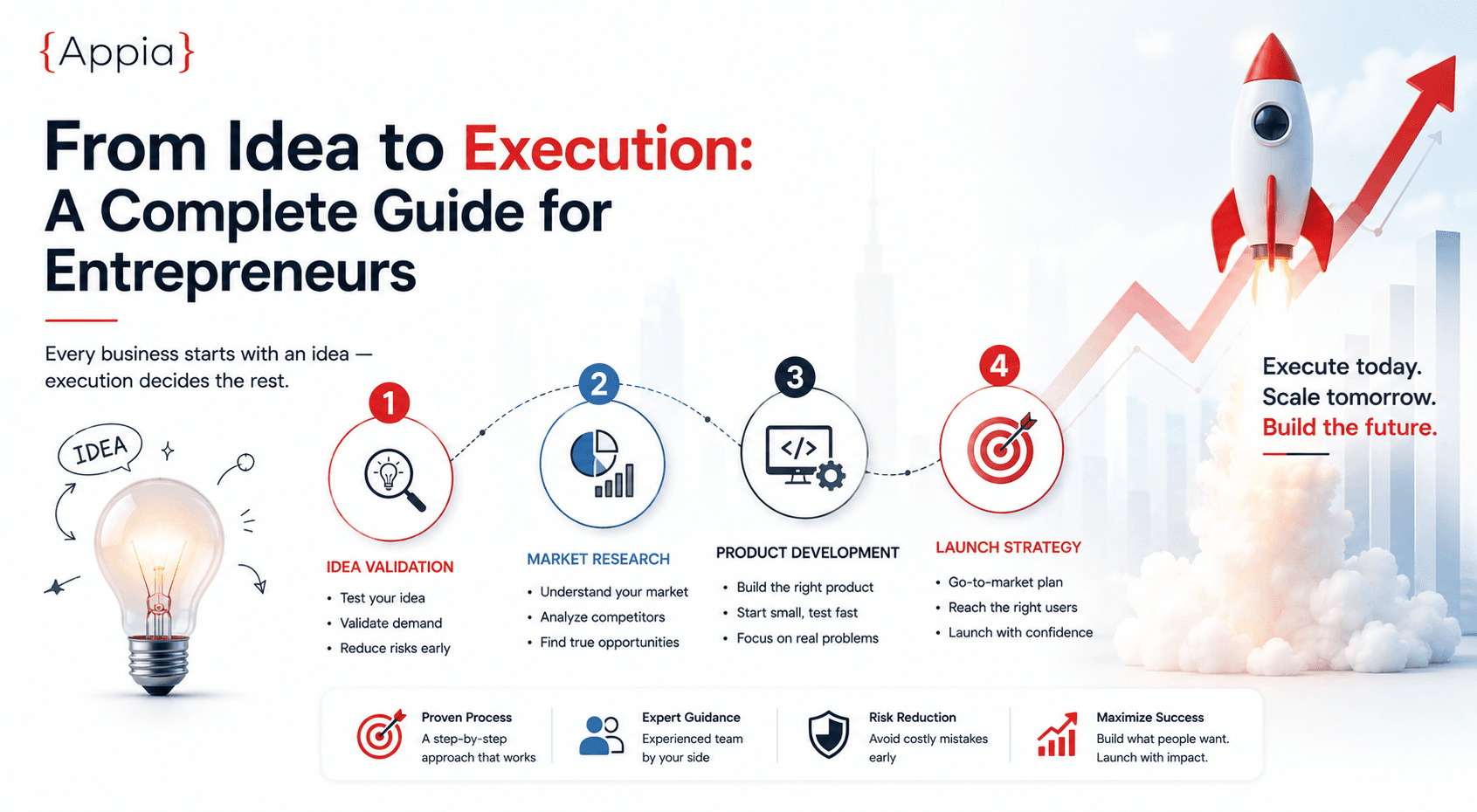
Every business starts with an idea — execution decides the rest
Every successful business starts with an idea, but execution is what makes it successful. Founders often over-invest in refining the idea and under-invest in the unglamorous work of validating and building it.
The four stages we guide entrepreneurs through
At Appia Consultation, we guide entrepreneurs through every stage:
- Idea validation
- Market research
- Product development
- Launch strategy
Why the order matters
Skipping straight from idea to product development is the most common, and most expensive, mistake. Validation tells you whether the idea is worth building at all. Market research tells you how big the opportunity actually is and who else is already serving it. Only after both of those does product development have a clear target to aim at.
What "validation" actually means in practice
Validation isn't a survey asking people if they'd use your product — most people will say yes to be polite. Real validation looks for evidence of demand: pre-orders, waitlist signups, a landing page that converts, or a manual version of the service that people actually pay for before you've built any software.
Building the smallest version that answers the real question
Product development at this stage isn't about building a complete product — it's about building the smallest version that tests your riskiest assumption. Every feature that doesn't help answer whether people will actually use and pay for it can wait.
Execution with a plan, not a hope
Our goal is to reduce risks and maximize success by providing expert guidance and technical support at each stage, so that by the time you're ready to launch, you're launching something you already know people want, with a strategy for reaching them instead of hoping they find you.
How long each stage should actually take
There's no universal timeline, but as a rough guide: validation is measured in weeks, not months — if it's taking longer than that, the experiment is probably too complicated. Market research runs in parallel with the tail end of validation, since some of what you learn from talking to prospects doubles as market intelligence. Product development for a true MVP should be measured in weeks as well; if it's stretching past a couple of months, the scope has likely grown past "smallest version that tests the assumption."
What a landing-page test actually proves
A landing page that converts tells you people are interested enough to give you an email address or a card number — it doesn't tell you they'll still be interested once the product actually exists and has rough edges. Treat it as a signal to keep going, not a guarantee. The next-cheapest test after a landing page is usually a manual or semi-manual version of the service delivered to the first handful of signups by hand, before any of it is automated.
Common mistakes we see at each stage
- Idea validation: only asking people if they'd use it, instead of asking them to commit something — money, time, or a waitlist signup
- Market research: researching the market size but not who's already serving it, and how well
- Product development: building features nobody asked for because they're technically interesting to build
- Launch: building the launch plan after the product is done instead of alongside it
What to bring to a first conversation
If you're not sure which stage you're actually at, the most useful thing to bring to a first conversation isn't a full business plan — it's whatever evidence you already have, even informal: conversations you've had, a rough landing page, a spreadsheet of who you think the customer is. That's usually enough to figure out honestly whether you're still validating or ready to build.
Why this order still applies to funded startups
Founders with funding sometimes assume they can skip validation because they have the budget to build first and find out later. The order still applies — it just means a funded team can afford a faster validation cycle, not that they should skip it. Capital makes it easier to survive a wrong guess, but it doesn't make the guess less wrong, and it's still cheaper to find out before writing code than after.
A simple way to tell if you're ready for the next stage
Each stage has one exit condition worth being strict about: validation is done when you have evidence of real demand, not polite interest. Market research is done when you can name who else serves this need and why a customer would choose you instead. Product development is done when the smallest version has actually answered the riskiest question, not when the backlog is empty. If you can't state that condition for the stage you're in, it's usually a sign to slow down before spending more on it.
If you're sitting on an idea and not sure which stage to start at, let's talk through it.