
Insights
Why Digital Healthcare is the Future
The healthcare industry is rapidly evolving with the help of digital technologies, making services faster, smarter, and more accessible.
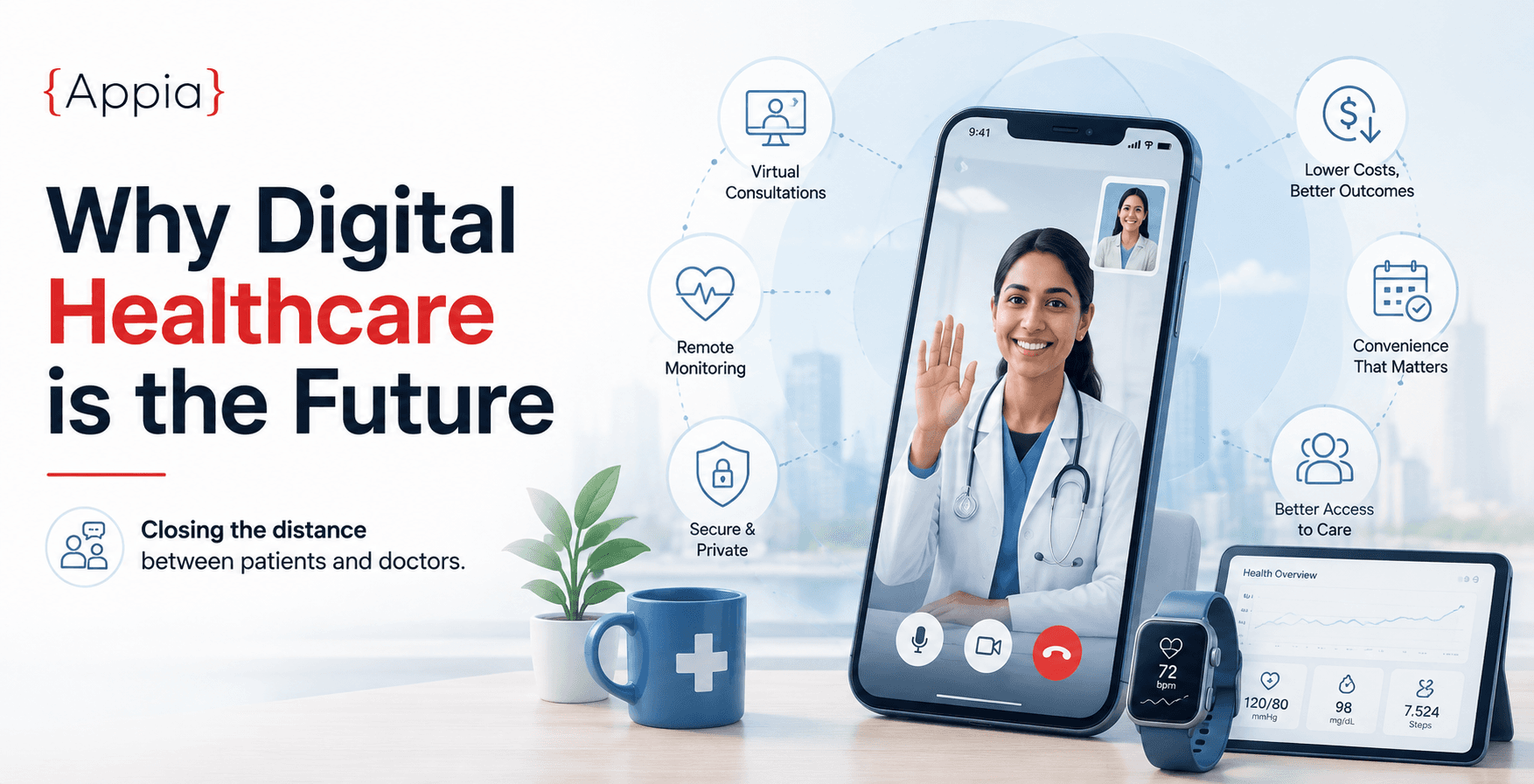
Closing the distance between patients and doctors
From telemedicine to online consultations, digital healthcare solutions are bridging the gap between patients and doctors — particularly for people who'd otherwise face a long drive, a long wait, or both just to get a routine question answered.
The cost side of the equation
They reduce operational costs, improve diagnosis speed, and offer convenience to patients worldwide. A virtual consultation costs less to deliver than an in-person visit for both the provider and the patient, and that cost difference compounds across a full patient population.
Where digital healthcare is strongest
Digital tools are most valuable for the visits that don't need a physical exam: follow-ups, prescription renewals, triage before deciding whether an in-person visit is needed at all. Routing these through a digital channel frees in-person capacity for the visits that actually require it.
Remote monitoring and chronic care
Not every use case is a one-off consultation. Connected devices — blood pressure cuffs, glucose monitors, wearables — let providers track chronic conditions like diabetes or hypertension between visits instead of only at scheduled checkups. That continuous view catches problems earlier than a quarterly appointment can, turning "how have you been feeling" into an actual data trend a provider can act on.
Mental health made more reachable
Teletherapy removes some of the biggest barriers to seeking mental health care: no waiting room, no need to explain a mid-day absence from work, and a lower first step for someone who isn't sure they're ready to talk to someone in person yet. It doesn't replace in-person care for every situation, but it's often the difference between someone getting care at all and putting it off indefinitely.
Privacy and security aren't optional
None of this works without patient trust, and trust depends on how data is handled. Video visits, remote monitoring, and online intake all mean more health data moving across networks — which means providers evaluating digital healthcare tools need to treat data protection, encryption, access controls, and compliance with regulations like HIPAA in the US as a core requirement, not a feature to bolt on later.
The adoption gap digital healthcare doesn't solve by itself
Digital healthcare assumes a smartphone, reliable internet, and comfort navigating an app — none of which are universal. Rolled out carelessly, it can end up serving the patients who were already easiest to reach while leaving others further behind. The providers getting this right treat digital channels as one option alongside in-person and phone-based care, not a full replacement for patients who aren't set up to use it.
What it doesn't replace
Digital healthcare works best as a complement to in-person care, not a wholesale replacement. Physical exams, diagnostic imaging, and procedures still need a clinic. The value of digital tools is in removing the friction around everything that doesn't.
Where this is heading
The trend isn't "healthcare goes fully digital" — it's providers building a clear digital front door: intake, triage, and follow-up handled online, with in-person capacity reserved for what genuinely needs it, remote monitoring in place for chronic conditions, and real attention paid to who the digital channel might be leaving out. That's the shift worth planning for now, not waiting on.
What a "digital front door" actually includes
In practice, a digital front door means a handful of concrete pieces working together: online intake forms that populate the patient record instead of getting re-typed by staff, a triage step that routes patients to the right type of visit before they ever see a provider, self-scheduling for the visits that don't need a phone call, and a follow-up flow that doesn't require the patient to remember to book their own next step. None of these pieces individually looks like a big transformation — the value is in having all of them connected.
Interoperability is the quiet blocker
A digital healthcare tool that can't exchange data with the systems a provider already uses — the EHR, the billing system, the lab — creates a second record instead of replacing manual work with less of it. Providers evaluating new tools should ask specifically how data moves in both directions before evaluating anything else about the feature set; a well-designed app that requires double data entry usually gets abandoned within a few months.
Measuring whether it's actually working
The metrics that matter are less about adoption numbers and more about what changed operationally: did no-show rates for follow-ups actually drop, did average time-to-first-appointment shorten, did staff time spent on scheduling and intake go down. A digital healthcare rollout that improves patient satisfaction survey scores but doesn't move any of these operational numbers is usually solving the wrong problem.
What a rollout plan typically prioritizes first
Providers moving toward a digital front door typically start with online intake and self-scheduling for follow-ups, since those touch the most patients with the least clinical risk, before extending into remote monitoring or teletherapy, which require more clinical and compliance groundwork to do well.
If you're a healthcare provider figuring out which parts of your patient journey belong online, we can help you map it out.