
Insights
Digital Engineering Services: Build, Modernize, and Run Software That Scales
"Digital engineering" gets used loosely, so this is the practical scope: full-stack product and platform work, delivered by one team that stays accountable after launch instead of handing the system to someone else to run.
What "digital engineering" actually covers
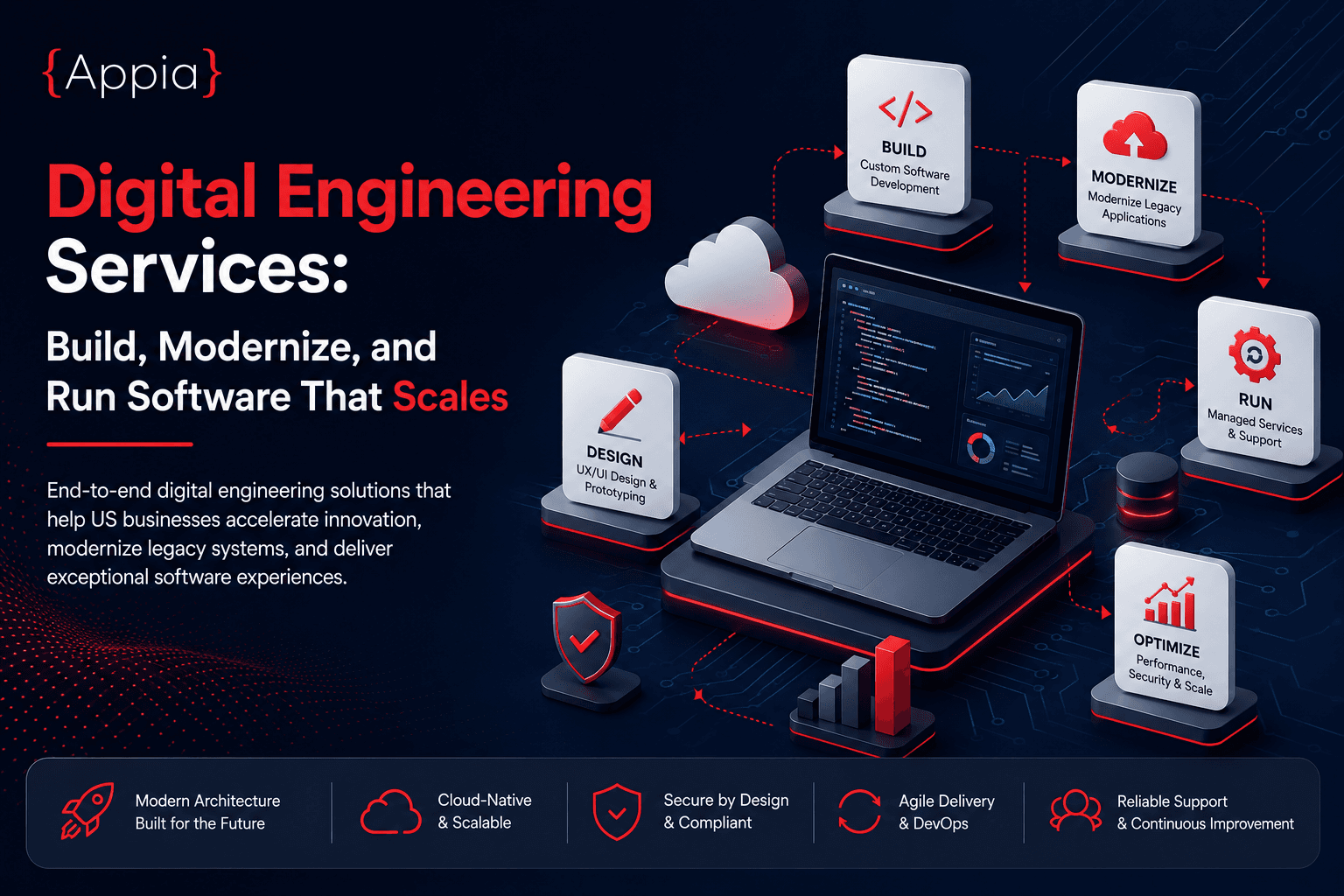
The term gets used loosely, so here's the practical scope: digital engineering is full-stack product and platform work — frontend, backend, cloud infrastructure, and the operational practices that keep it running — delivered by one team instead of handed between a build vendor and a separate ops vendor. It spans three situations:
- Greenfield builds — a new product or platform built from scratch
- Modernization — replatforming, refactoring, or migrating a legacy system without a risky big-bang rewrite
- Run — ongoing reliability, performance, and feature work once the system is live
Define, Build, Run: why the handoff is the real risk
The most common failure mode in software delivery isn't bad code — it's the handoff. A team builds something, ships it, and moves on, and the people who inherit it don't have the context to run it well. We structure engagements around three explicit phases instead:
- Define — scope, architecture decisions, and success criteria agreed upfront, including what "done" and "healthy in production" mean
- Build — full-stack delivery against that definition, with the same team that will support it afterward
- Run — ongoing ownership: monitoring, incident response, performance work, and incremental features
Keeping Define, Build, and Run inside one accountable team removes the gap where something works in the demo but nobody knows why it's slow in production.
Modernization without a rewrite gamble
Legacy modernization is where digital engineering earns its keep. A full rewrite is rarely the right call — it's slow, risky, and often re-introduces bugs the old system had already worked around. The more reliable path:
- Map the system's real behavior, not just its documented behavior — legacy systems accumulate undocumented business logic
- Strangle, don't replace — route new functionality through new services while the legacy system keeps running, migrating piece by piece
- Instrument before you touch anything — you need production metrics on the old system to know if the new one is actually better
This is slower to start than a rewrite but dramatically lowers the odds of a failed migration taking down something business-critical.
Multi-stack teams, not single-framework specialists
Digital engineering work rarely fits one stack. A team that only knows one framework will either force-fit it where it doesn't belong or hand off to a second vendor mid-project. Appia builds teams around the problem — React or Next.js for the frontend, whichever backend and cloud stack fits the constraints of existing infrastructure, compliance requirements, and team familiarity — rather than selling a single-stack template to every client.
Engagement models
Digital engineering work fits three shapes, depending on how much ownership you want to keep in-house:
- Project delivery — we own a defined scope end-to-end, from Define through a handoff you're ready for
- Embedded pod — a dedicated team working inside your existing product org, sitting in your standups and sprint planning
- Run or support retainer — for systems you already built, where you need ongoing reliability and feature work without hiring internally
Where to start
How we scope Define before anything gets built
The Define phase isn't a formality — it produces artifacts the team is actually held to later: a record of the major technical decisions, a list of what "healthy in production" means in measurable terms (latency targets, uptime, error budgets), and an explicit list of what's out of scope. Skipping this step is the single most common reason a "quick project" turns into a much longer one — not because the work was harder than expected, but because scope was never actually fixed.
What "run" costs in practice
Teams underestimate how much ongoing run work costs relative to the initial build. A system that took twelve weeks to build can easily need several hours a week of monitoring, dependency updates, and incident response indefinitely after launch. Pricing this in from the start — as part of the engagement, not a surprise six months later — is part of what the Define phase is for.
How we evaluate a legacy system before touching it
Before recommending strangle-and-replace or any other approach, we look at three things: how much undocumented business logic is actually embedded in the current system (usually more than anyone remembers), how tightly coupled the pieces are, and what the real failure cost is if something goes wrong during migration. That evaluation, not a general preference for modern architecture, is what determines the migration plan.
What determines the right engagement model for you
Project delivery fits best when the scope is well-defined and you don't need the team long-term. An embedded pod fits when you have ongoing product work and want engineering capacity inside your existing process, reporting to your product lead rather than ours. A run/support retainer fits teams that already have a system built — by us or anyone else — and need reliable ongoing ownership without hiring a full internal team for it.
If you're deciding between a rewrite and a modernization path, or trying to figure out whether an embedded pod or project delivery fits your team better, that's a shorter conversation than it sounds. Get in touch and we'll help you scope it before anything gets built.