
Insights
C2C Staffing & Dedicated Developer Teams: How Appia Helps Enterprises Ship MVPs Faster
Hiring takes months you don't have when a deadline is fixed and your core team is already stretched. Here's how Appia's C2C staffing, staff augmentation, and dedicated developer team models give you senior engineering capacity in days instead — and two examples of how that's played out in practice.
What is C2C staffing?
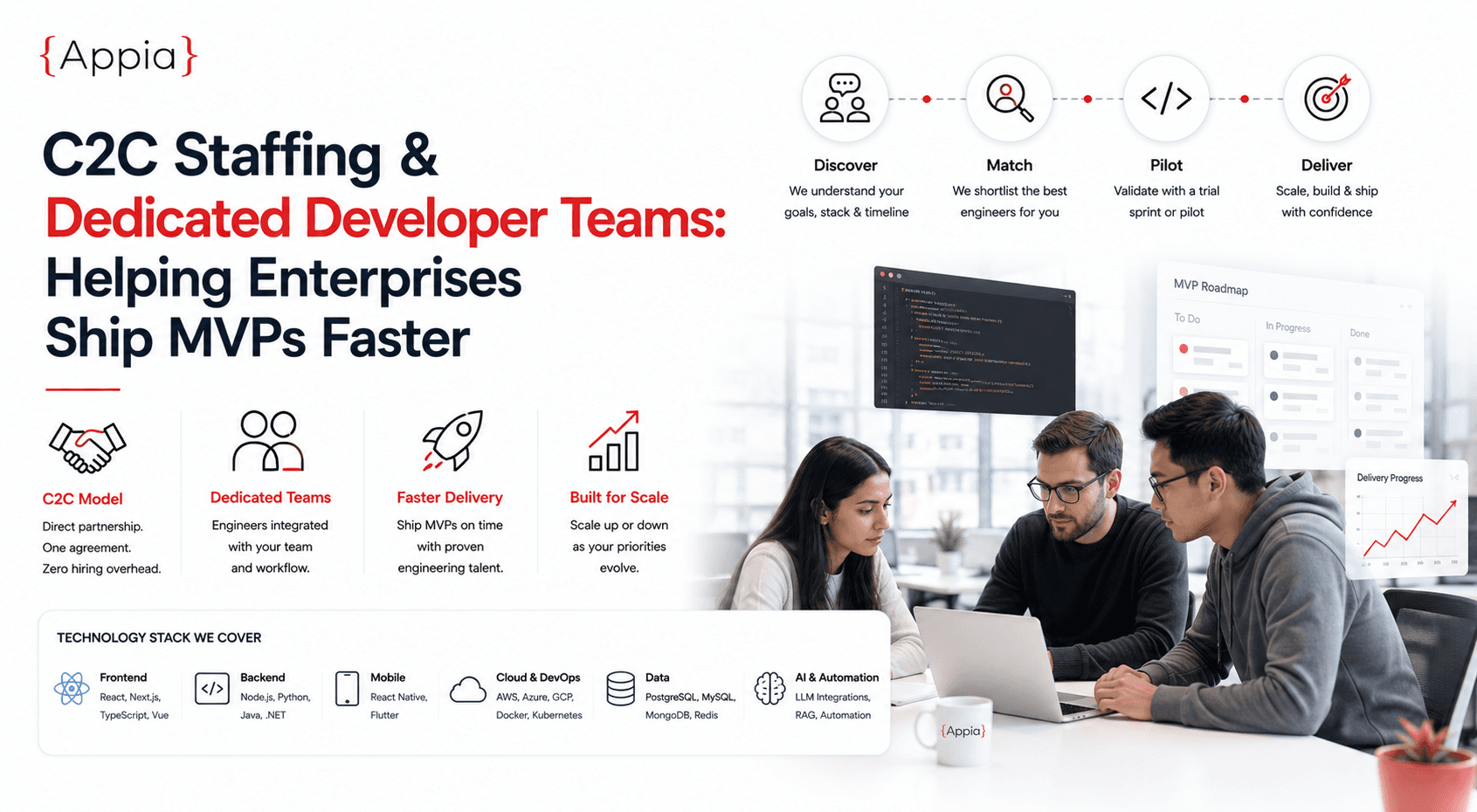
Corp-to-Corp (C2C) staffing is a contracting model where Appia enters into a direct business-to-business agreement with your company, rather than placing individual contractors on your payroll or routing everything through a recruiting agency. You get a single master service agreement, one point of invoicing, and engineers who show up ready to work inside your existing process, without the overhead of running your own hiring pipeline, background checks, or contractor paperwork for every seat you need to fill. It's the model enterprise teams tend to prefer when a project has a hard deadline: legal and procurement sign off once, and every engineer added after that is a line item, not a new hire.
Staff augmentation vs. dedicated developer teams
Not every engineering gap needs the same fix, so we offer two core models. Staff augmentation embeds one or two Appia engineers directly into your existing team — they join your standups, use your tools, and report to your leads — to cover a skill gap or a hiring freeze without disrupting how your team already works. A dedicated developer team goes further: Appia assembles, manages, and backs up a full pod, typically three to six engineers plus a lead, that operates as a self-contained extension of your engineering org. You set direction and priorities; we handle recruitment, performance management, and continuity if someone needs to be swapped in.
The technology stack we bring
Our engineers are cross-trained across at least two stacks each, so one person leaving mid-project never stalls your roadmap. Depending on what you're building, that typically covers:
Frontend: React, Next.js, TypeScript, Vue
Backend: Node.js, Python (Django/FastAPI), Java (Spring Boot), .NET
Mobile: React Native, Flutter
Cloud & DevOps: AWS, Azure, GCP, Docker, Kubernetes, CI/CD pipelines
Data: PostgreSQL, MySQL, MongoDB, Redis
AI & automation: LLM integrations, RAG pipelines, workflow automation
Every engineer we place has already shipped production code in at least one of these stacks for at least three years, and goes through a paired technical review before we ever propose them for a role — the goal is that your team spends its first week reviewing real pull requests, not explaining the basics of your codebase.
Real results: helping enterprise teams finish MVPs fast
One of our clearest results came from a staff augmentation engagement with a leading global CRM and enterprise software platform. Their core engineering team was fully committed to the main product roadmap when a time-boxed internal tools MVP came up with no bandwidth left to build it. We placed two senior full-stack engineers under a C2C agreement who plugged directly into the client's existing sprint cadence and codebase from week one, working in their tools and reporting to their own leads. Within six weeks, the MVP shipped, tested, and in production ahead of the original deadline, without the client running a single job posting or interview.
A similar story played out with a top-tier global IT services and consulting firm that was delivering an MVP for one of its own enterprise clients and needed extra engineering bandwidth mid-project to hit a hard delivery date. We came in through a dedicated-team arrangement, contributing frontend and backend engineers who worked inside the firm's own delivery process and reporting lines rather than as a separate outside vendor. The MVP was completed and handed off on schedule, with our engineers integrated closely enough that the end client never had to think about how many vendors were actually involved in getting it built. In both cases, the win wasn't just extra hands — it was extra hands that didn't need a ramp-up period the deadline couldn't afford.
How an engagement works
Getting started is deliberately fast:
A discovery call to scope the tech stack, timeline, and team size you actually need
A shortlist of matched engineers, or a proposed pod, within days rather than weeks
A trial sprint, or a paid pilot, so you can validate fit before committing long-term
An ongoing engagement with a dedicated point of contact, regular check-ins, and the ability to scale the team up or down as your priorities shift
Why companies choose Appia
- Fast ramp — engineers onboard into your existing workflow in days, not weeks
- Flexible scope — scale from one developer to a full dedicated pod without renegotiating contracts
- Continuity — the same engineers stay with your project end-to-end instead of rotating contractors
- C2C simplicity — one agreement, one invoice, none of the overhead of managing individual contractors directly
If your team needs engineering capacity to hit a deadline, whether that's one senior developer or a full dedicated pod, talk to us about a C2C staffing or staff augmentation engagement built around your stack and your timeline.